
Artificial intelligence & education news
How much is AI being used to gather information and produce stories about schools by reporters at outlets including Chalkbeat, the New York Times, EdNC, the 74, and Hechinger Report?

Despite the massive attention that artificial intelligence (AI) tools are receiving in the worlds of education and journalism, education-focused outlets have mostly been slow to formalize or publicize their policies on what is and is not acceptable use of AI by reporters — much less to actually produce AI-assisted education coverage
The education journalists we talked to for this story are experimenting with how new tools can help them work better and faster — or avoiding them all together. But there is a lot of hesitancy to talk about the subject.
Those who were willing to speak to us see promise in AI tools for office management tasks; and some education reporters have also used AI to scrape large troves of documents. What education reporters do not seem to be doing so far: using these tools to write.
“I think I’m noticing a little bit of resistance in my peers to availing ourselves of artificial intelligence,” says Lucinda Breeding-Gonzales, an education reporter at the Denton Record-Chronicle in Texas. “I think we’re afraid of it — for good reasons. But I think the more resistant we are, the less proficient we could become.”
“I think education reporters…have to be comfortable and proficient with artificial intelligence,” says Breeding-Gonzales.
“I think I’m noticing a little bit of resistance in my peers.”
- Lucinda Breeding-Gonzales (Denton Record-Chronicle)
Outlet Policies
At least one education outlet is giving chatbots a byline — at least in very specific circumstances.
News and policy outlet EdNC has a strict prohibition on staff writers using generative AI to write or edit. If guest authors use it, however, the publication asks them to explain how AI was used and the chatbot is listed as a co-author according to Analisa Sorrells Archer, senior director of policy at EdNC.
Archer said the policy tries to strike a balance between disclosing AI usage without excluding people who might be less confident writers.
“We might just be setting aside a lot of voices that otherwise wouldn’t have access to a platform to publish their work,” Archer said.
ChatGPT even has its own author page at EdNC with a biography: “OpenAI trained a model called ChatGPT, which interacts in a conversational way with users to create content.”
The page includes 11 stories listing the chatbot as a co-author, and at the bottom of each is a note about how ChatGPT was used — standardizing verb tenses, correcting grammar errors and assisting in flow.
But even at an organization that clearly has considered many of the implications of AI usage, EdNC does not yet have a formal internal or external policy on AI, Archer said.
According to Sarah Darville, Chalkbeat editor in chief, the outlet adopted a formal policy last year on using AI tools — including a firm prohibition on using AI to write stories published under a reporter’s byline.
“The principles we’re operating from: use approved, more secure tools; maintain human oversight; understand AI’s limitations; be transparent; and embrace innovation that serves our mission,” she said in an email to The Grade, adding that specific details may change but those basic guidelines are likely to be at the heart of the policy.
“It’s not a replacement for coverage, and we’re not trusting AI to get these things right,” said Chalkbeat’s Eric Gorski in a Poynter article about local newsrooms experimenting with AI. “It’s more like a news tip.”
Unfortunately, there is no beat-specific policy guidance that education journalists can look to.
The Education Writers Association (EWA) says they have not formed any specific guidance.
“We definitely plan to keep covering AI in our programming and other resources -- both as a resource to reporters in their coverage of the issue, and a resource for their own use,” said EWA interim executive director Debbie Veney in an email. “We’re tracking member interest in the topic and hope to continue to provide the resources and support they’ll need on these complex issues.”
EWA did recommend a guide from the Public Media Journalists Association, a series of four panel discussions including demystifying AI and a discussion around ethics along with guidance on using it to clean up audio or track public records.
Editors at The 74 and The Hechinger Report declined to comment for this story.
However, several non-education outlets have already set clear guidelines.
The Associated Press have made their AI usage policies public, which encourages experimenting with ChatGPT through an agreement but to treat it as an “unvetted source,” not to use it to modify any photos, video or audio and not to use it to “create publishable content.”
Earlier this spring, Christianity Today Magazine published its AI policy that allows its writers to use AI as a “souped-up search engine” but not to contribute to “any aspect of the planning and writing process.”
The Education Writers Association (EWA) says they have not formed any specific guidance. Editors at The 74 and The Hechinger Report declined to comment for this story.
Using AI for background tasks
The lack of standard guidelines is not stopping education reporters from trying out new tools.
Those who spoke to The Grade generally followed a similar set of guidelines to what Chalkbeat has adopted.
“[I] cannot imagine [AI] writing a text that I filed,” said Greg Toppo of The 74 in a phone interview. “That just seems absolutely horrifying to me.”
Toppo said that reporters at The 74 discuss usage of AI, but there hasn’t been any formal guidance provided by the company.
He also hasn’t found AI works much better than a traditional search engine for research. But it helps with other tasks — one in particular is finding and adding links to prior coverage of a topic to his reporting.
Breeding-Gonzales at the Denton Record-Chronicle in Texas said she is the only one in her newsroom who seems truly comfortable with AI, mostly using Gemini and Co-Pilot.
“I do not use it to write stories at all,” Breeding-Gonzales said. “I don’t use it to come up with questions for sources, I don’t feel like I need that.”
Mostly she uses it for scheduling — for example, working back from a deadline to create a set of steps when reporting a story or finding pockets of time for training.
As someone who uses AI regularly, she is also very familiar with its shortcomings — Gemini has provided incorrect information when asked to summarize legislation, she said as one example.
Using AI to help research stories
Above: The New York Times’ Dana Goldstein talks to AEI’s Rick Hess about her experiences using AI for reporting purposes.
Some journalists have found that AI can generate and sift through massive databases of records.
The New York Times’ Dana Goldstein spoke last year on an AEI video podcast (above) about how she could now use Gemini to search through BoardDocs to find information in public meeting minutes — although the work did need to be double-checked.
“Of course you have 13,000 school districts [nationally] and I’m interested in contracts with say a certain company and it can — whshh! — you know, can surface them,” she said. “Wow! Well that’s actually hugely powerful for me as a reporter.”
Chalkbeat Detroit’s Hannah Dellinger told Nieman Lab how she used the database LocalLens to search transcripts of local school board meetings and find sources to interview.
“I’m not able to physically go to every single board meeting,” Dellinger is quoted saying in the Nieman Lab piece. “Even watching them online, or looking at all the agendas, can take up an entire day.”
In one case highlighted in the story, Dellinger tracked down a teenager who shared about being bullied at a school board meeting four hours away from Detroit.
Some journalists are even starting to use the tools for data collection and analysis.
Google’s Pinpoint helped Sahan Journal’s Cynthia Tu analyze thousands of pages of tax filings by charter schools to find contracting information.
Tu and her colleague Becky Dernbach gathered 172 tax forms from Minnesota’s 180 charter schools, then used PinPoint to search the documents and extract the information on private contractors receiving state funds.
“Adding all those numbers together, we saw that Minnesota charter schools gave out at least $132 million in state funding to independent contractors in the 2021-22 tax year alone,” Tu wrote in an explanatory piece that accompanied the investigation.
“Without the help of AI, Becky and I would have spent days sifting through the tax documents to try to assemble this number.” - Sahan Journal’s Cynthia Tu
The final frontier: AI-written education stories
There is at least one journalist who has — briefly — published AI-generated education news.
For a few weeks this past winter, Slow Boring’s Matthew Yglesias operated a DC-focused newsletter of “AI-generated data-based journalism” with the credit “Prompting by Matthew Yglesias.”
Called Ten Miles Square, the newsletter included education stories about public school demographic shifts and the “collapse” of charter school network KIPP DC. But the Substack published about a dozen stories in February and was abandoned.
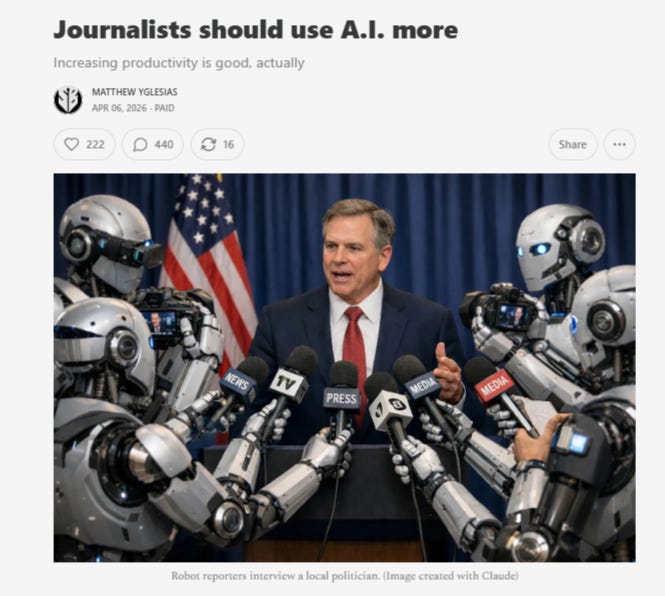
Above: Yglesias reflects on his foray into AI-generated journalism.
Last month, Yglesias defended his effort to “generate pretty good journalism on the basis of basically zero human labor,” and urged others to make more and better use of AI in producing trend stories, which “have lost most of their economic value, but they continue to be socially valuable.” But he also admitted that producing human-free news was irresponsible.
For now, it seems, AI will remain a potential supplement to traditional reporting for most education journalists.
Note from the author: I used Otter.ai to transcribe interviews for this story and Grammarly to help copyedit for spelling and grammar errors (although not style). All direct quotes have been checked against the original recording and all em-dashes are entirely my own.
Abraham Kenmore is a freelance reporter and producer based in Durham, North Carolina. He covers politics and policy across the South. You can follow him on bluesky and X.
Previously from Kenmore in The Grade
The ‘Northern nosedive’ in the news
Why homeschooling coverage misses the mark
Previously from The Grade
AI on the education beat (newsletter item)
ChatGPT’s views on education journalism
Related reading
Local newsrooms are using AI to listen in on public meetings (Nieman)
Journalism students are more skeptical of AI than you (Poynter)
Is A.I. a Journalist or Just a Newsroom Tool? (NYT)
What impact is generative AI having on journalism? (Reuters)
 | A guest post by
|