
ICE interference, "We are the media now," & WaPo ed beat layoffs: 🏆 Best Education Journalism of the Week 🏆 (02/06/26)
All the best education journalism, media commentary, & newsroom changes.
In this week’s newsletter:
📌 Worsening ICE interference near schools in Minneapolis and other places
📌 Filling the childcare gap after disaster strikes
📌 ‘We are the media now,” says a famously combative education influencer
📌 WaPo layoffs affect 3 current and 2 former education journalists
📌 Kids write to ICE about a missing classmate
DEPORTATION AND SCHOOLS
The big education story of the week:
The big education story of the week is the increased focus of deportation efforts near schools — and the pushback against federal encroachment.
In Minneapolis and other places like Los Angeles, federal deportation efforts are increasingly being reported near schools (K-12 Dive, Chalkbeat). Students, parents, and staff in affected areas are staying home, self-deporting, or being detained (LA Times, The 74, NYT, MPR, New Yorker, Tribune News Service, MPR, AP).
In response, a handful of school districts and local teachers unions have sought to make schools protected spaces as they have been in the past (Sahan Journal, EdWeek, MPR, The Hill, Washington Post). Responding to public pressure and student walkouts, federal officials have returned some but not all of the students and parents who have been detained (Sahan Journal, AP, MPR).
School-adjacent deportation efforts are important because they involve vulnerable kids and essential public services — and they represent a shift in deportation efforts that have generally stayed away from schools in the past. Follow local education reporters like MPR’s Elizabeth Shockman, Sahan Journal’s Becky Dernbach, The 74’s Beth Hawkins, and the Star’s Mara Klecker. “They’re tearing it up,” says Hawkins about local coverage she feels I haven’t given enough attention here. “You should be embarrassed.”
Other big education stories of the week include the ramping up of state and federal school choice programs (EdWeek, WSJ, Texas Tribune, Chalkbeat Tennessee) and the debate over prolonged delays in returning to in-person schools after the recent storms (Chalkbeat TN, Baltimore Banner, NJ.com).
HOMESCHOOL REGULATION, DELAYED REOPENING, & POST-DISASTER CHILDCARE
The best education journalism of the week:
🏆 ‘These kids are invisible’: Child abuse deaths spur clash over homeschool regulation
After several well-publicized cases of homeschool abuse, state legislators are starting to look at whether more reporting and oversight of home education is necessary. This piece from Stateline’s Anna Claire Vollers nicely covers the groups battling it out in state capitols over whether, for example, to allow a parent to begin homeschooling during an abuse investigation. The debate will become increasingly relevant as homeschooling grows as part of the educational mix.
🏆 More D.C.-area schools are opening after the snow. Here’s what took so long.
Kids in the nation’s capital region finally started returning to school this week after a snowstorm on Jan. 25 and the Washington Post’s Nicole Asbury, Karina Elwood and Jonathan Edwards provide a solid roundup on what took so long. The unusually bad ice and sleet impacted the whole region — in some cases breaking snowplows and endangering wide-turning school buses. See also MoCo Banner.
🏆 She offers free child care after disasters. It’s a lifeline as families rebuild their lives.
There’s been some excellent recent reporting about the impact of natural disasters on schools and education, but it’s rare to see a story on the impact of natural disasters on childcare. This profile from the 19th’s Jessica Kutz (also republished in Hechinger Report) follows an organization that steps in when wildfires, hurricanes and other disasters destroy preschools and shutter childcare centers. Not only is the story engaging and detailed, but it also gives a clear sense of the scale of the challenge facing many communities.
Other stories we like include Nevada school budget heyday was short-lived. Why several districts are now in dire straits (Nevada Independent), How D.C. allowed ‘completely inappropriate’ spending by anti-violence group (Washington Post), and Milwaukee Public Schools switches literacy curriculum midyear, costing $7.9M (Milwaukee Journal Sentinel).
Magazine articles and Substacks of note: What Black Youth Need to Feel Safe (The Nation), Stop Meeting Students Where They Are (The Atlantic), Ed tech is profitable. It is also mostly useless (The Economist), & The media, public agencies should be more cautious about scaring people (Angie Schmitt).
‘WE ARE THE MEDIA NOW’

In a new video interview, I ask controversial school choice advocate Corey DeAngelis who’s covering school choice, why red states don’t have better schools, what guardrails the federal school choice program needs, why he hasn’t joined the Trump administration — and whether his own recent experiences with cancellation have changed him.
Selected clips:
‘We are the media now,’ says DeAngelis, who claims to know more about social media accounts than traditional news outlets or bylines.
“I don’t like it when academics or reporters for that matter pretend to be unbiased but then only report one side of the story.”
Other interviews we shared this week include Arkansas Democrat Gazette education reporter Josh Snyder, who covers school choice full-time, Media Nation’s Dan Kennedy on the ‘softness’ in everyday news coverage, and Boston School Facts’ Vernée Wilkinson on the disconnect between parents, school districts, and local news coverage.
PEOPLE, EVENTS, & MORE

Above, left to right: Asbury, Rosenweig-Ziff, and Elwood.
📰 Layoffs: The massive layoffs at the Washington Post included Karina Elwood and Nicole Asbury, who covered Virginia and Maryland schools, respectively. Higher education reporter Dan Rosenzweig-Ziff was also let go, as were former education reporters Molly Hensley-Clancy and Emmanuel Felton. The Atlanta Journal-Constitution also let 50 people go, but we hear no one on the education coverage team was cut. The Baltimore Banner is expanding to Prince George’s County, but no word yet on whether there will be a new education reporter.
📰 Numbers: Schools added 118,000 new employees last year for 135,000 fewer kids. The number of school-age students in traditional public schools has dropped from 77% pre-pandemic to 74% — a drop of 1.5 million students. Only three of the top states for enrollment loss have expansive private school choice programs. Boys are scoring roughly a year behind girls in reading, but a new study suggests that isn’t inevitable. The attempted firing of staff from the Department of Education cost between $28.5 million and $38 million. The USDE will be funded for another year after Trump signed a $79 billion spending bill. Ransomware attacks on schools declined 9% last year over 2024.
📰 Books: The Wall Street Journal reviewed the brand-new “On This Ground: Hardship and Hope at the Toughest Prep School” by Anthony DePalma. In the National Review, Stanley Kurtz is unconvinced by James Traub’s new book on classical education. ICYMI like we did, The Guardian excerpted Stefan Merrill Block’s new book “Homeschooled” last month. And looking ahead to May, we’ll be looking for “Unchartered: How One Public High School Transformed First-Generation College Success“ by Erika M. Kitzmiller. “This book asserts that educational journalists, officials, practitioners, and researchers should carefully consider how to build on and showcase public schools’ strengths,” Kitzmiller tells us.
📰 People: The Baltimore Banner team of Greg Morton, Liz Bowie and Ryan Little won first place in the 2025 Philip Meyer Journalism Award from IRE for a piece on challenges facing Baltimore kids trying to get to school on time. It’s finally being reported that former Boston school board member Brandon Cardet-Hernandez was not renewed for his position after having been an occasional “no” vote on the mayorally-appointed board. Education historian and school reform critic Diane Ravitch has a new Substack addressing hot topics like the problem with the science of reading. Adam Harris is not only back at The Atlantic; he’s also publishing poetry. And ICYMI like I did, MPR’s Elizabeth Shockman published a book about an American ballerina in Russia last year.
📰 Quotes
“Pretending these cuts are to reach more Americans…is just insulting to people’s intelligence.”
“There are somehow zero quotes in this article from parents who are happy that Mayor Bowser reopened the schools.”
“There’s a fine line between healthy caution and giving people agoraphobia.”
“The utopian claims about edtech were disappointing, but most evidence does actually point to positive, if modest, gains.”
“The hirings will continue until enrollment improves 🤣.”
KICKER
Always save the best for last.
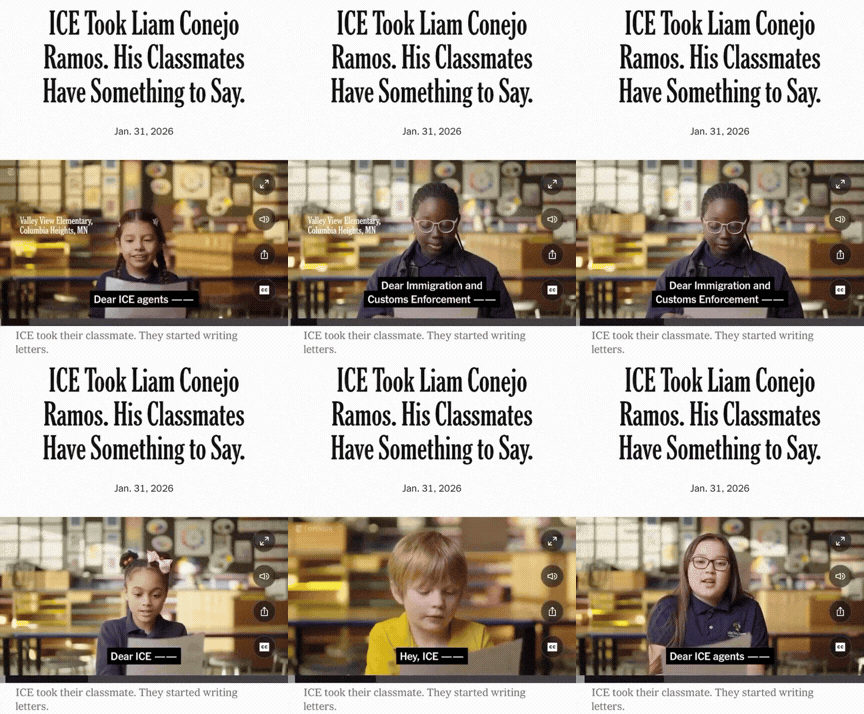
“ICE Took Their Classmate. They Started Writing Letters.”
That’s all, folks. Thanks for reading!
With research and writing from Abraham Kenmore.
Pretty sure it was The Teachers who made the kids get in front of the cameras to "send ICE a message" just like it was decided By The Teachers & Staff Administrators to pull kids from class & Put Them On City Streets To Protest ICE that led to Parents To Remove Their Children For Having No Say In The Matter. We send our children to be Taught in Reading, Science, History & Math NOT TO BE INDOCTRINATED PAWNS IN YOUR PERSONAL POLITICAL AGENDA !!!!!