
In defense of 'Abbott Elementary'
The hit TV mockumentary about an under-resourced Philadelphia public school is stubbornly optimistic — and that’s not a bad thing.

It’s October. Though most American schools have been back in session for weeks, we’ve only just now reached the first day of school at Abbott Elementary (Abbott). The ABC comedy, created by and starring Quinta Brunson, returns this fall for its fifth season today.
By and large, it’s been four years of effusive praise and discourse in the digital town square. However, alongside the boilerplate criticisms that any TV show might encounter, Abbott has also faced a specific genre of critique — that is, in some way or another, the show has failed to go far enough in illustrating the myriad challenges facing public schools.
A 2023 essay in the Hechinger Report argued that Abbott was more “palatable” than honest:
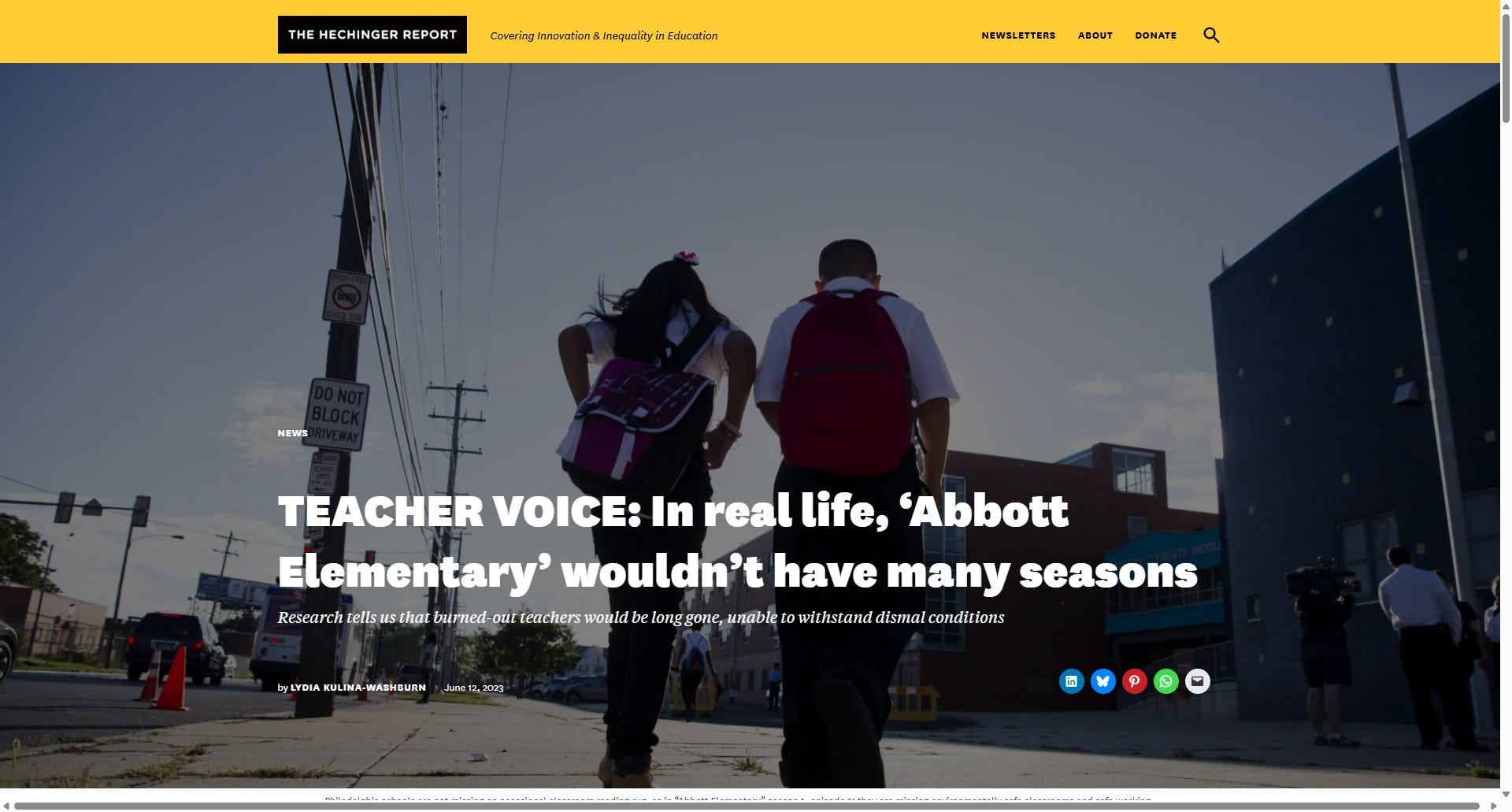
Author Lydia Kulina-Washburn, an English teacher in Philly, further noted that the program was “progressive enough to appeal to a 2023 audience, but misrepresents systemic issues that have characterized school communities and led to burnout for decades.”
I can’t speak to Abbott from the perspective of an educator, but as an artist, I think a lot about the relationship between form and content.
And my view on Abbott is that any assessment of the series should pay close attention not only to its stubborn optimism but also to its mockumentary format.
Without the optimism and the format, Abbott would be a fundamentally different, and possibly worse, show. And a show that no one watches isn’t going to inspire much discourse at all.
Without the optimism and the format, Abbott would be a fundamentally different, and possibly worse, show.
Both the critics and the streets agree; (almost) everyone loves Abbott.
Within a year of the show’s December 2021 premiere, Sheryl Lee Ralph secured her first-ever Emmy win — going viral in the process — for her performance as veteran teacher Mrs. Barbara Howard.
In total, the show has stacked up 4 Emmy wins and 30 nominations. The New York Times called Abbott “the kind of comedy that network TV needs, and that education deserves.” And the list of bona fide celebrities vying for a guest spot on the show is so long that the casting team keeps track of them using a “Love Abbott“ list.
Along the way, Abbott has drawn awareness to the challenges public schools face to a large audience that might otherwise be unaware. However, throughout its run, Abbott has been called on to do more — understandably so.
Only 16% of U.S. adults actively believe that the K-12 system is moving in the right direction.
And Abbott reaches millions of viewers, including some portion of the 44% of childless American households that likely have little to no insight into the public school system.
In 2022, after the deadly mass shooting at Robb Elementary School in Uvalde, Texas, Texas, viewers appealed to Brunson to create an episode that tackles school shootings.
In 2024, another Philly-area teacher opined in the Philadelphia Citizen that Abbott sugar-coats classroom disruption:
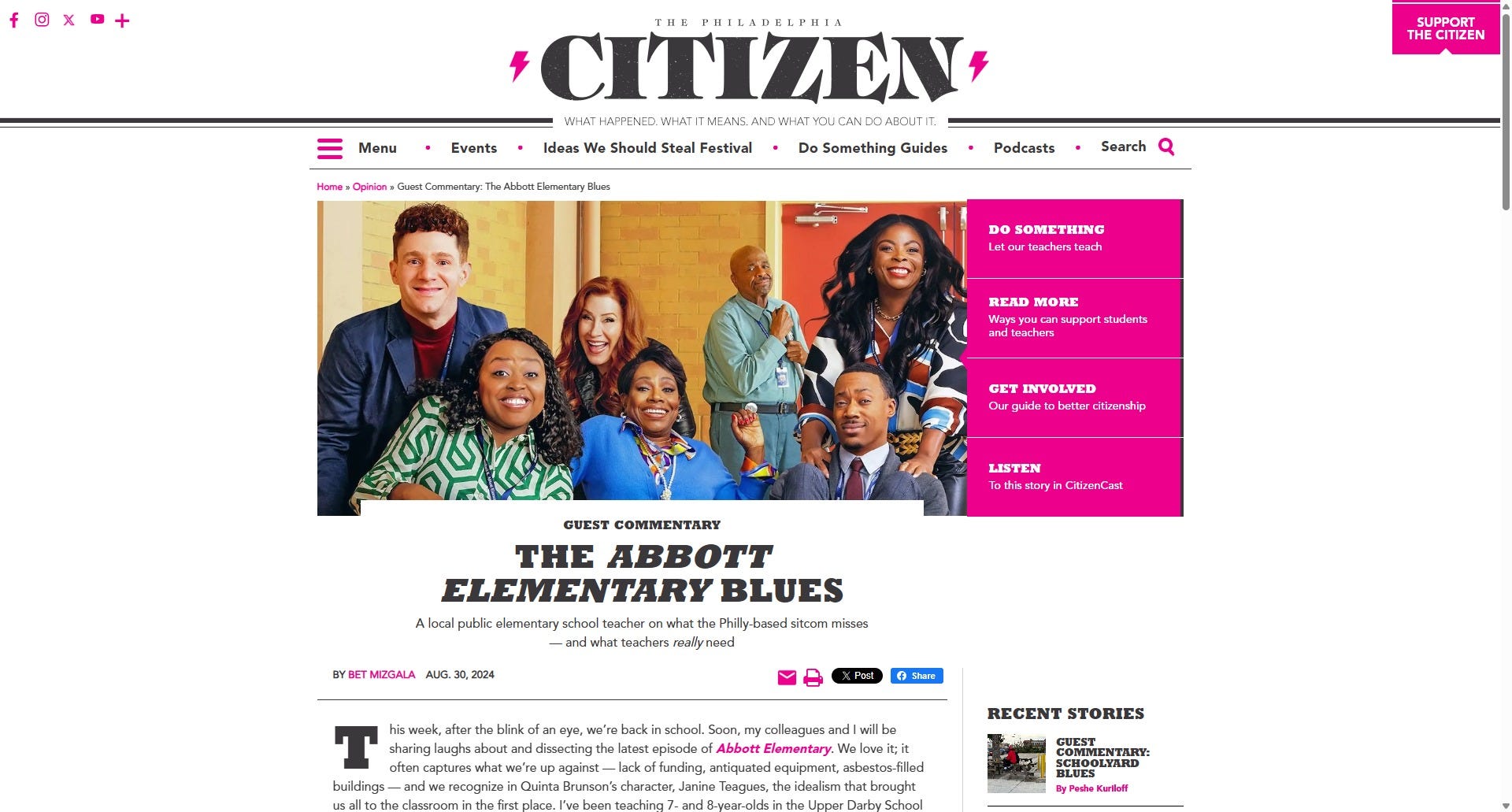
And a recent Thread from writer Patricia DeAnna alleges that the show “romanticiz[es] neglect.”
Despite it all, the show has stayed true to its light-hearted nature.
A recent Thread from writer Patricia DeAnna alleges that the show “romanticiz[es] neglect.”
Big Mouse doesn’t need a plebian like myself to defend their hit show’s choices, but I think it’s important to remember that Abbott’s form is a mockumentary.
The notion of surveillance is woven into the conceit of the show. Being on-camera could feasibly make students less likely to act out, and staff members less inclined to be too forthright about their challenges or too critical of their employers.
Unless the camera operators are in stealth-mode, zooming in on an intimate moment from behind a closed door (as was the case when the crew caught Mr. Eddie [Tyler James Williams] cradling himself on a desk during a ringworm outbreak in season four), Abbott Elementarians are aware that they’re being recorded, and try to act accordingly.
And yet, because perfect vigilance is impossible, the show is filled with little moments of characters self-censoring or backtracking in response to being on camera.
In the season three episode “Breakup” Mrs. Howard speaks about why she’s less-than-popular with her church choirmates—they don’t approve of her being friends with her queer colleagues, whom she euphemistically refers to as “colorful.”
Later in that same episode, Mr. Eddie turns sheepish after being caught bobbing his head to Mrs. Howard’s performance of the Mary Mary song “Shackles.”
The characters are trying (and sometimes failing) to conform to a “camera-ready” version of themselves.
Let’s take the thought experiment one step further. In the world of Abbott, these filmmakers collect hours of footage every day, and these hours are condensed into consumable thirty-minute summations. This implies that somebody is sifting through mountains of content and using their own authorial voice to decide what’s important and what can be left on the cutting room floor.
The characters are trying (and sometimes failing) to conform to a “camera-ready” version of themselves.
The idea of authorial voice is actually central to the season two episode “Attack Ad“, albeit in a slightly different way.
Mistaken for members of the usual documentary crew, a second film crew comes into the school. They record their own material and fashion it into a scenery-chewing advertisement that promotes charter schools at Abbott’s expense.
We see that the orchestrator of this scheme’s authorial voice leads him to portray Abbott as an unredeemable disaster class of a school. And we see the teachers reckon with the consequences of their image being molded to another’s design.
Abbott is doubly curated; first by the subjects in front of the camera, and then by the filmmakers behind it.
You may say, “Ekemini—you have no idea whether or not these implications of the mockumentary format were Brunson’s intention. For all we know, this is pure, unrefined copium on your part, an effort to defend a show that you enjoy.”
And. You may be right. Denial ain’t just a river in Egypt and all that jazz.
In the context of our collective high anxiety around the state of American schools and the kind of access to American eyeballs that primetime television provides, I get why folks would desire an Abbott that lists “dispensing sobering truths” among its key objectives.
Instead, the world of Abbott has whatever the opposite of the “third world filter” might be; rather than a yellow tint that signals an inhospitable environment, the rose-colored gloss of an inevitable Disney™-style happy ending covers Willard R. Abbott Elementary School.
Every single episode demonstrates that lack is at the core of these students’ experiences, and yet our ragtag ensemble of committed teachers always finds a way to make something out of nothing.
I agree that this approach, while entertaining, is somewhat politically anemic. But to be totally honest, I’m ok with that because I’ve seen the alternative.
I’ve experienced plays that were “right,” that objectively held the moral high ground, that were not, in my humble opinion, well-constructed pieces of dramatic literature.
For example, The Haunting of Lin-Manuel Miranda by Ishmael Reed accurately diagnoses the mega-popular musical Hamilton’s whitewashing of early American history — no, Sally Hemings wasn’t a benign companion to Thomas Jefferson — but it was bad. And bad plays don’t achieve their aims of proselytizing the masses towards their cause. One, because they aren’t likely to be produced, and two, because on the off chance they are, they won’t be convincing.
If Abbott hit harder but got worse in the process, rigorous popular discourse about the education system would still be undermined because the show would reach fewer people.
If Abbott hit harder but got worse in the process… the show would reach fewer people.
I propose an alternative mode of viewing Abbott.
I believe that those of us with an interest in ameliorating the issues facing public schools should watch this mockumentary with the same critical eye with which we (hopefully) watch actual documentaries: an eye that understands that the content we’re consuming is informative, but ultimately biased by both its subjects and its creators.
And therefore, we should take this piece of media not as a nugget of unvarnished truth to be internalized, but as an invitation to do more research for ourselves. We could stand to be more skeptical.
Actually, at least one person is already moving in this direction.
Dr. Sara Jones, Assistant Professor of Elementary Education at Illinois State University, taught a class titled “Public Education’s Possibilities and Predicaments: Exploring Portrayals of Critical Issues in ‘Abbott Elementary’” two consecutive spring semesters.
In it, she used Abbott, not as an end-all-be-all, but as an “entry point” for critical discussions.
We don’t have to let academia have all the fun.
Ekemini Ekpo is a writer, theatre-maker, and retired Twitter fiend. She’s written for Urban Omnibus, New York Review of Architecture, 3Views, Howlround Theare Commons, and more. She’s also a former New City Critic fellow (Architectural League of New York/Urban Design Forum), and an alum of the Vox Writers Workshop. Follow her @e.u.ekpo.
Previously from The Grade
Why does everyone downplay classroom chaos?
A career educator calls on parents and journalists to resist dismissing the everyday chaos that engulfs too many classrooms.
The actor who plays a polarizing history teacher on Netflix’s hit TV show “Adolescence” defends the show’s depiction of schools and teachers.
Inside the mind of the ‘cool’ teacher
A conversation with Tony Award-winner Gabriel Ebert, who plays a charismatic (but creepy) English teacher in the hit Broadway play ‘John Proctor Is the Villain.’
Why’s there so little coverage of everyday teacher racism?
The “slow violence” of everyday teacher racism rarely gets the attention it warrants, according to researcher Ranita Ray.
Lessons from the media’s coverage of the 1996 Ebonics controversy
A long-forgotten uproar illustrates some of the chronic failures of media outlets covering polarized, racially charged situations.
Education and race: 9 journalists reflect on their coverage
Current and former education reporters share their thoughts on education coverage, race in the newsroom, and their own work.
 | A guest post by
|
I appreciate that Abbott shows the joy of teaching and the love of students that is also part of the struggle for people in schools. Maybe watch The Wire season alongside easier shows. Where does "Mr. Iglesias" fit in these critiques?