
Shut up about edtech opt-outs
Parents are right to be concerned about edtech, but individual parent opt-outs will create havoc in the classroom.

Everywhere I look, I read about parents who want to opt their kids out of edtech programs and for what they consider good reasons.
Recently parents in Lower Merion, Pa. made national headlines when the school board, despite an outpouring of concerns, refused to eliminate 1:1 devices in the district.
This trend of parental demands to limit or eliminate technology use in public schools is also occurring in Los Angeles Unified School District (which recently passed policy on limiting technology use), Palo Alto Unified School District (the literal center of Silicon Valley), Arlington Virginia Public Schools, as well as other districts across the nation.
Parents are not making up the issues that overuse of technology have brought to students, and there are plenty of teachers to support these same concerns.
But here’s what I can tell you, based on all my experiences as a teacher, administrator, and parent: opt-outs won’t work.
Opt-outs will not solve the persistent problems that are plaguing our students and in fact, can lead to even bigger problems in instructional experiences at school.
Here’s what I can tell you, based on all my experiences as a teacher, administrator, and parent: opt-outs won’t work.
In a time when technology is advancing faster than anyone can keep up, via Artificial Intelligence (AI) and post-Covid schooling, initial research findings have many parents, educators, and those in medical fields concerned about the impact on students.
The result is that parents are asking many questions. Some are going as far as demanding that their children not use digital devices or that they are extremely limited during the school day. Parents are insisting that if the district will not solve this concern, they are at least able to “opt out” of their own children using devices in school.
Parents are right to be concerned. Many students are not using technology in class to support or advance their learning; instead, they are scrolling through YouTube, TikTok, gaming, and watching sports with no oversight.
Also, students are rapidly learning how to use AI to cheat and avoid most reading assignments by using AI generated summaries. For the overstretched teacher, these behaviors can be near impossible to prevent or address immediately.
And before we go any further, no, I do not blame the teachers for this!
Parents are right to be concerned. Many students are not using technology in class to support or advance their learning.
In response to the outcry from parents, a number of different approaches are occurring in public school districts across the nation.
First, many school districts are looking at technology usage, and in some cases, limiting time spent on devices based on grade levels.
Second, is a sort of parent revolution – the demand to opt their child out of technology use in school.
Kudos to those districts and states for understanding that though research is fairly new, waiting on further studies to support limiting technology use is not the answer.
However, many districts are finding themselves in the situation where they have invested multimillions of dollars to convert everything to an online format (text books, student activities, teacher feedback, extension activities) and the choice to limit students on screens comes with very real problems.
I am fairly adamant that individual student opt-outs of technology will create an absolute nightmare for the classroom teacher, and I see no feasible way of effectively running a class where some students are not permitted to use technology.
Inevitably, there will be gaps in access to materials, possible delays in assessing work that is not online, and a social disconnect that creates a huge classroom dynamic issue for the teacher.
I see no feasible way of effectively running a class where some students are not permitted to use technology.
Imagine a fifth-grade class learning about cell structure. The teacher would likely introduce this concept via some visuals shown on the classroom smart board, introduce vocabulary associated with the parts of the cell, and describe the purposes of each cell part.
Because the science materials are online (decided by the district and not the teacher) the follow up activity has students working on an application that allows them to explore the cell structure and parts that is engaging and insightful. The responsibility of creating activities that are not online for students with opt outs then becomes a task for the teacher.
My guess is she would create some sort of coloring and labeling activity. How long before one of the students sees that the computer activity is more fun and engaging and wants to do that instead of a worksheet? Then add the situation when a student goes home and tells their parents they want to work on the computer in class, but the parent refuses.
Who deals with this conflict each and every school day? Do we really think that an alternative teacher-created activity will provide the same educational experience for students? Now imagine this teacher having to do this every day, in each content, in a district that has fully transitioned to digital learning. Is this really what we want our teachers spending time on?
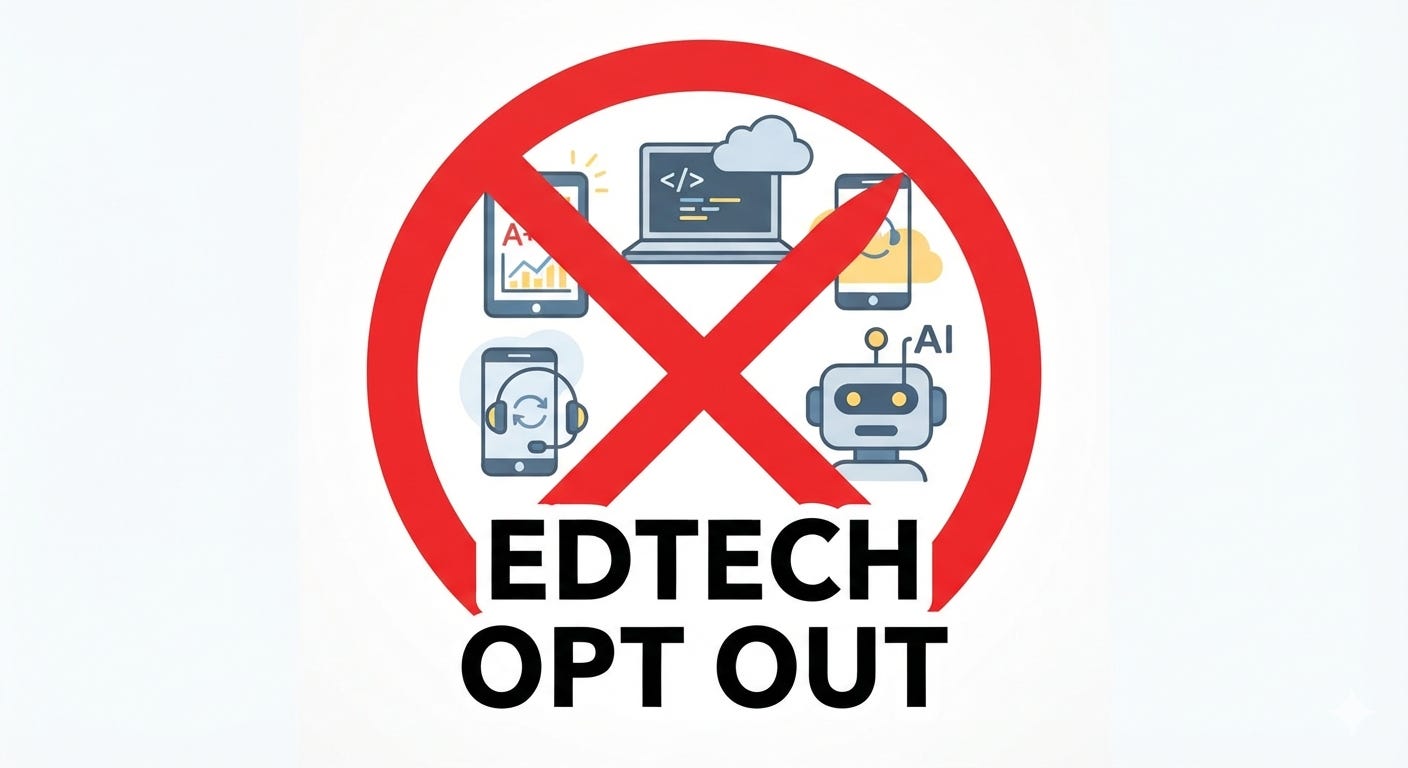
I respect parents wanting to opt out their children from technology, but the reality is that this is not going to work in our current model of public education. It will create a dual classroom and in some cases can lead to student isolation, a lack of diversity in any group work (only digital students can work with digital students), and substandard experiences for students who are not permitted on computers.
Public schools by their nature are essentially a “one size fits all” approach to education, and they are currently doing a mediocre job at individualizing and differentiating instruction. A student with an opt out of technology in school is not going to have a better education experience whatsoever.
Public schools by their nature are essentially a “one size fits all” approach to education, and they are currently doing a mediocre job at individualizing and differentiating instruction.
As polarizing as this may sound, my recommendation for parents who do not want their children using 1:1 devices, or extensive technology during the school day, is to either homeschool or find a private school that aligns with your desires regarding technology.
Asking a school or teacher to create an approach to learning for a student not allowed to use technology is unreasonable, and to feel differently is to be completely clueless to how public education currently works (or not works depending on your perspective).
Smart school districts are doing the following: listening to parental concerns, limiting technology use by grade level, and training teachers in Artificial Intelligence so they have the skills to teach this to their students. These school districts already have cohorts of teachers in specialized AI training, they are already creating limits on screen exposure, and they are including parents on committees to further explore technology use going forward.
I encourage parents to refrain from insisting on opting a child out of technology and to expend this energy on advocating for significant guardrails on its use in schools. I also encourage families to limit technology use at home to help mitigate the time a child is online daily, as it is the epitome of hypocrisy to insist a child learns screen free, but to provide that child with a smart phone and gaming system at home. Understand that the evolution to a better use of technology in public schools is a huge undertaking and will take time, especially when districts have invested so much money in online materials.
I respect the impatience many parents are experiencing as they question the use of technology in schools, but investing time in attending school board meetings, asking a Principal to form a school committee of parents and teachers to openly discuss concerns, and mitigating technology exposure at home is a far better approach than opting a student out of the technology and possibly creating an even worse situation.
Gail Johnson has spent 38 years in public schools, from teacher to Principal to post-retirement substitute teacher. You can find and follow her on Twitter/ X.
 | A guest post by
|