

I’ve written about the New York Times’ Nikole Hannah-Jones more than 10 times over the past 15 years — probably more than most. Like many others, however, I have had strong feelings about her latest piece.
My beef — as an education journalist and as an admirer of her work — is not so much that she’s reversed herself (repeatedly) but rather that she’s missed the chance to stand up for the vulnerable kids she’s so often said she’s championing — both now and in the past.
Over the past decade, Hannah-Jones used her prodigious talents and efforts to build herself into a national conscience on the inadequate education so many children receive. However, she’s also betrayed her followers at least twice in the past, and does so again with her latest piece.
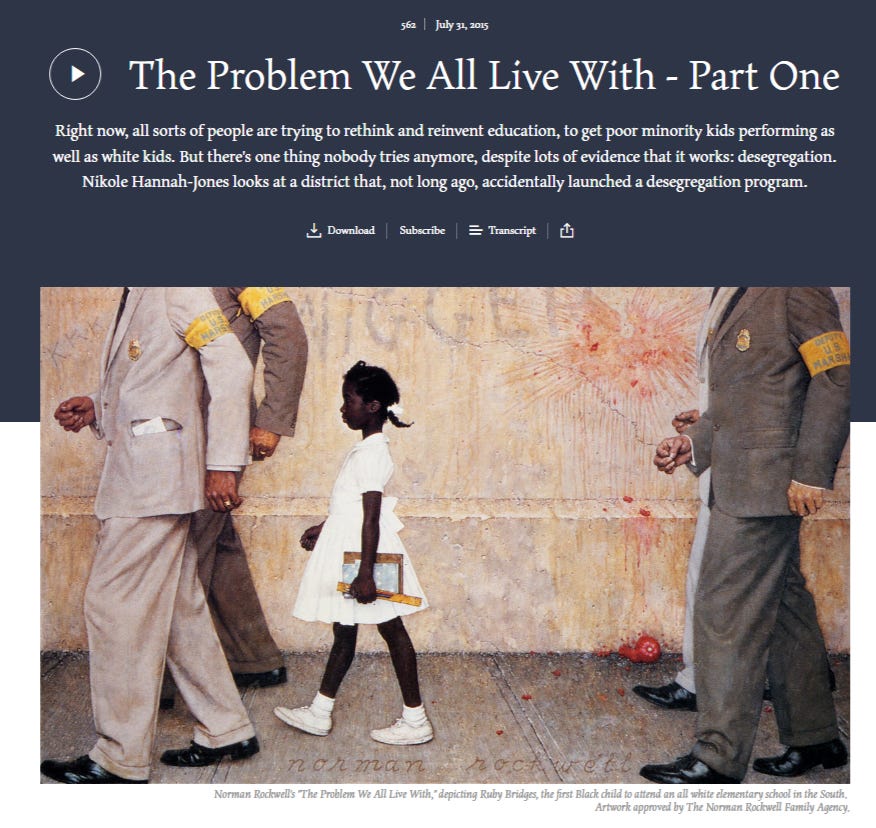
First, she convinced most of us with deeply reported stories that school segregation was the core problem we should all be writing about — and that integration was the obvious solution. This was a conclusion she soon abandoned by choosing PS307 for her daughter, but whose misguidedness she has never fully acknowledged.
Her certainty had been unnerving. Her blatant reversal was vexing. But I’d experienced something similar in the past from Diane Ravitch. And I was at the time deeply committed to the notion that lack of racial diversity on the education beat was a major impediment to powerful coverage — and hoped that Hannah-Jones might lead education journalism to a deeper place it needed to go.
Four years later, given the chance to lift up her kid’s school and everyone else during the pandemic, she reversed herself again. That was much harder to absorb.
One heated weekend in May 2020, Hannah-Jones complained loudly and vehemently about lack of live instruction being provided to vulnerable kids like those at her daughter’s school — then quickly apologized for the appearance of “teacher bashing” and largely disappeared from the debate:
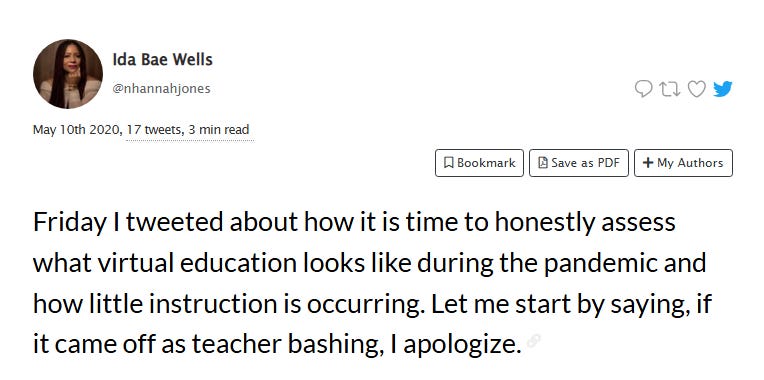
At the time, I remember being concerned about the unfair treatment she was receiving. Looking back now at what appears to be the full thread that I’d long thought had been deleted, I can see how she’s blunting one critique while continuing to press on her main point. From seeing a webinar PowerPoint deck, I know that she had pressed journalists to ask hard questions about what services were being offered to vulnerable kids.
However, the debate about schools being shut down without virtual instruction was Hannah-Jones’ chance to be a real hero — to stand by her school choice decision, to help the nation see how miserably it was treating vulnerable kids, to help break the sorry impasse that limited remote learning and kept blue cities closed for so long.
There was no one I can imagine better positioned to change minds and prompt action. But Hannah-Jones abandoned the effort no more than 72 hours into the fight, and subsequently did little writing on the topic.
Here in 2026, Hannah-Jones is again missing the moment. Given a chance to focus attention on the inadequacies of too many schools — and the possibilities shown by many others — she’s instead reversed herself yet again (by sending her kid to a screened school) and downplayed the existence of caring, learning-oriented schools that serve all kinds of kids in New York City and nationally.
For me, this is all too familiar, and the stakes for are too high.
Previously from Alexander Russo
No, asking questions about remote learning isn’t ‘teacher-bashing’ (May 2020)
Some Questions About This American Life’s School Integration Story
The sad part of this story is that the problems at these predominantly minority NYC schools cannot simply be attributed to a lack of funding. P.S. 307, the elementary school attended by Nikole Hannah-Jones’s daughter, currently spends more than $50,000 per student. It also has relatively small classes and substantial staffing resources. Teachers are well compensated, and the principal earns close to $200,000 a year.
Contrast that with many elementary Catholic parochial schools, which operate on dramatically smaller budgets (9-10k per student), generally pay their teachers considerably less (55-60k) , and often have larger classes—yet frequently achieve strong academic results and maintain orderly learning environments.
That raises an important question: if money and class size were the principal determinants of educational success, why can some Catholic schools achieve strong academic outcomes with far fewer resources?
Hannah-Jones’s own account seems to suggest that resources were not the problem. She describes failures of accountability, responsiveness, and academic expectations. Students should not be routinely promoted to the next grade without mastering the material required at their current grade level.
I don’t think NHJ was aiming for heroism. It’s interesting that she has become the target, instead of the underresourced, segregated, and racist NYC public school system. Clearly, you’re uninformed about the decisions and choices middle-class Black parents consider as they educate their children. My own children attended a suburban public school (primarily white), a Chicago public school (mostly Black), and finally a private school (mostly white). They’re now in their thirties and still talk about the racism from teachers and students they experienced. As parents, we observed the larger picture. Black children overdisciplined and labeled. Redistricting battles. Mishandled racial assaults from white students. I, too, have revisited those times and mulled over the decisions we made. Here we are in 2026 and nothing has changed. Actually, educating Black children is even more fraught. Yet we blame NHJ, not a system designed to grind up Black students.